Garage Door Off Track Repair in Russellville, AR
Rolling a door back onto its rails starts with bracing it. It is then rehung on straight rail with sound rollers, and whatever pushed it off gets corrected.
If the rollers on your Russellville-area door have popped out, it sits tilted or jammed, or a panel is bowed, it's off track. Stop using it, leave the opener off, and check any repairer with the Arkansas Contractors Licensing Board.
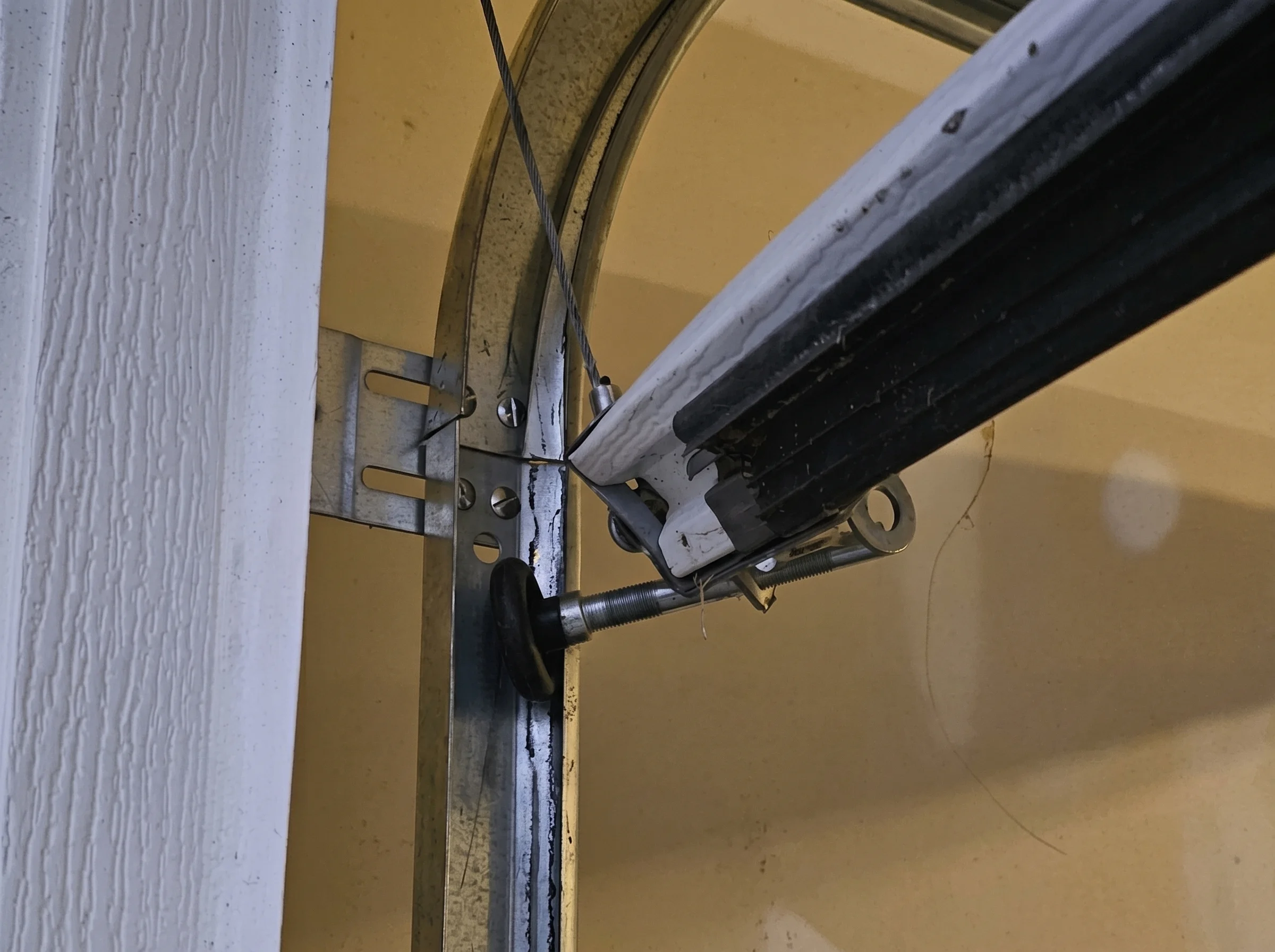
How an off-track door looks
One or more rollers out of the rail, mostly down low on the door or at the curve where the track bends up toward the ceiling above.
A door canted to one side or jammed, often stuck halfway.
A crimped or bowed panel, left behind by the opener forcing a stuck door.
Rail that's visibly bent, dented, or sagging away from the wall.
Scraping, popping or grinding from the door just before the derailment.
Door off the rails? Keep the opener unplugged and tell us the side that slipped and the cause.
Contact UsWhat knocks a door off track
A bumper strike
Reversing into a closed or half-open door tops the list of causes, and the bottom of the rail usually bends in the process.
A cable that let go
One side sinks, the door twists, and rollers pop free. A slack or broken cable is covered on the cable repair page.
Rollers past their life
A roller with a seized bearing drags instead of turning and jumps the rail at the first rough spot.
Rails out of true
Over years of door travel the lag screws holding the rail work loose, the rails spread, and eventually a roller finds the gap and drops out.
Something under the door
Federal rules require an opener to reverse on contact, but a bike or mower under the door can still do damage.
Secure the area
Leave the opener off
Pressing on regardless can crumple a panel or rip the rail from its fasteners.
Leave the red release cord alone when the door is partly open and derailed, because the door can drop or swing completely clear of the rail.
Never hammer rollers back in while the door is loaded. Even derailed, the door holds spring tension and can jerk free without any warning.
Keep away from the door; if a car is stuck inside, mention that in your first message.
What a repair involves
The door is propped and secured so it can't fall or slide mid-job, and spring tension is dealt with first where necessary.
Damage is sized up
How many rollers, how much rail, whether panels bent, and if a cable or spring began the chain of events.
Rail is trued or replaced
Light bends can be pressed true, while kinked or torn rail gets swapped.
Worn or broken rollers come out, and hinges are checked too, since a cracked one will toss a roller again.
The door is lifted back into the rails and the brackets tightened; it then runs through several complete cycles on the opener, after which force and travel get a second look.
Describe what happened to the door
A short note is plenty to begin with. Which part is damaged isn't something you need to work out.
Rollers
Rollers control the smoothness and noise of every cycle, and they tend to give out long before the door's other parts.
Basic steel rollers without bearings are the simplest design; they clatter and grind down the rail along with themselves.
Sealed-bearing nylon rollers are far quieter and need hardly any lubrication or attention.
Wobbling, flat-spotted, cracked or seized rollers are ready for replacement.
A door that's loud but not broken frequently needs little beyond new rollers, work that normally fits into a maintenance visit.
Factors behind an off-track repair bill
How far it came out
A pair of rollers at one corner, or the whole door hanging free.
Rail damage
Straightening against replacing, on one side or both.
New rollers and hinges where they've worn out.
Creased or cracked panels
A panel that's badly bowed may have to be replaced, and an older door can make finding a match hard.
A cable or spring failure that triggered it.
If one panel is beyond saving
A hard knock can leave panels bent past saving. A lone panel can often be replaced if the maker still sells it, and downtown Russellville's Historic District Commission reviews exterior changes.
When that isn't possible, or many panels are damaged, garage door installation outlines replacement choices.
Questions people ask
Can a roller be pressed back into the track by hand?
Maybe, if one roller popped out at the bottom of a closed door and there's no bent rail or loose cable. Beyond that, stop: the door is heavy, under spring tension, and able to move without any warning at all, even when it looks settled.
Why does it keep jumping out on one side?
Most often a rail that sits slightly out of line, a loose bracket, or a cable on that side that's off. Hanging it back without finding the cause invites a repeat performance.
Should the rails get oil?
No. Rails should stay clean and dry because oil attracts grit. Hinges, springs and roller bearings are what get lubricant.
More garage door help
Garage Door Spring Repair
Torsion or extension springs that broke, replaced with units rated for the door's weight.
Read more →Garage Door Installation
Replacement and new doors, from steel and composite to wood and glass, sized for your opening.
Read more →Reach out
Mention where it's stuck, which side slipped out, and whether a cable hangs loose.
A photo of each side, taken from a few feet back, is the most useful thing to send, and a repairer's state license is worth checking first.